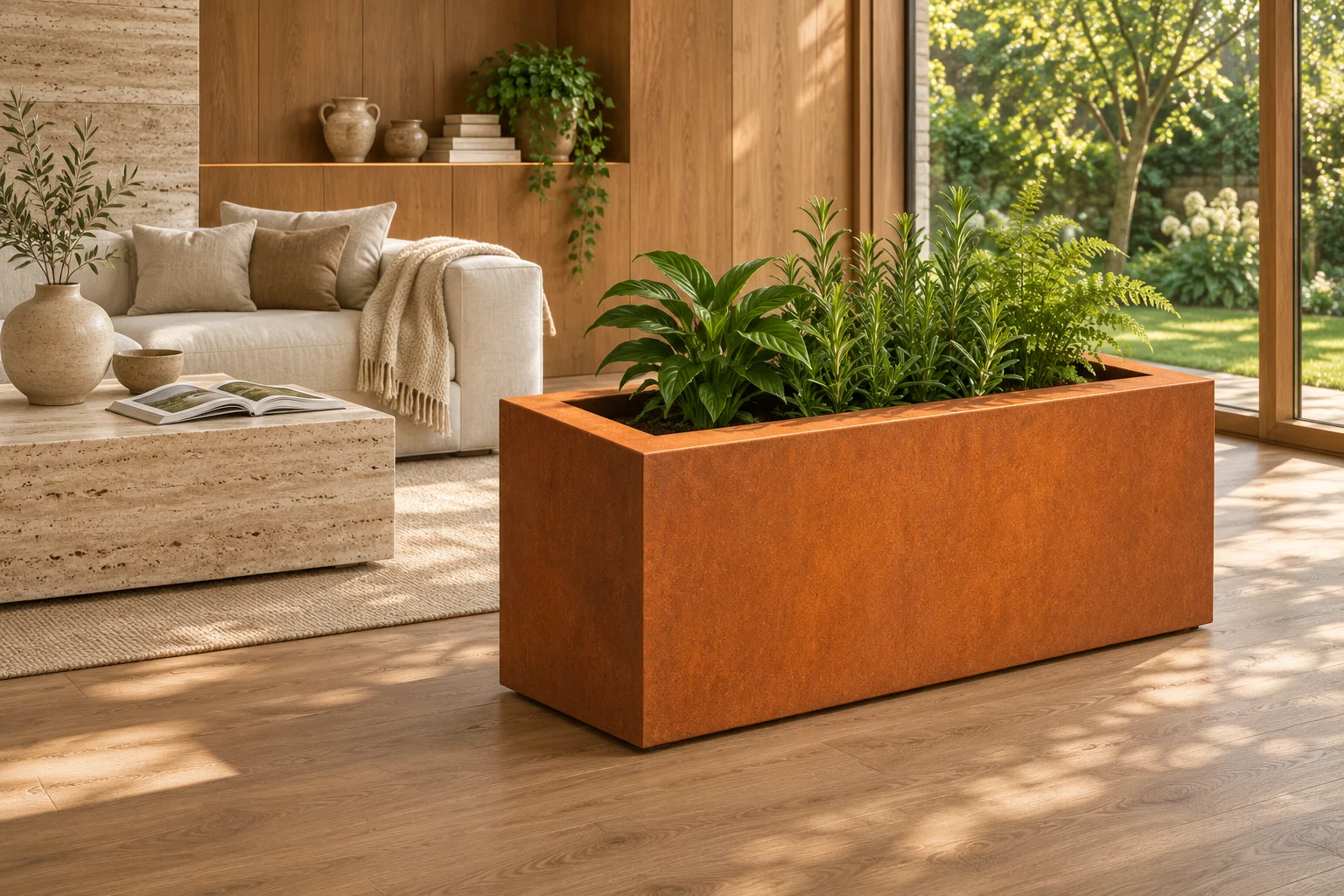
A corten planter for an interior should be ordered as a separately specified decorative body, rather than bringing a standard outdoor model into a room. Before fabrication, agree the metal surface condition, inner planting container, water collection and floor protection. These details determine whether the arrangement remains practical after its first watering.
Start with the plant and location. What pot is it in now? Can that pot be lifted out for watering? Where will water go if too much is added? Answer these questions before choosing the planter’s outside height. The checks below apply to homes, offices and restaurants, without promising suitability for every floor finish.
What changes when corten is indoors
Weathering steel’s protective patina develops through alternating wet and dry periods. In its recommendations for architects, SSAB cautions that patina cannot form evenly in continuously dry or wet conditions; for that reason, ordinary COR-TEN® use indoors is not recommended. You therefore cannot expect the same process in a room as in an outdoor installation.
If an interior calls for corten’s appearance, specify the decorative application separately: the surface condition at handover, expected contact and permitted care. “It will finish weathering indoors” is not a substitute. We do not promise one stabilising treatment or coating for every product. An indoor application needs an individually agreed construction and finish, rather than a general assumption about the material.
Separate the decorative body from the planting pot
One practical arrangement to discuss is a plant in its own pot inside the metal body. Choose that planting container for the plant’s needs; the outer planter provides the visual composition. University houseplant advice describes this double-potting approach while emphasising the need to drain and remove surplus water.
| Component | Purpose | What to check |
|---|---|---|
| Decorative body | External shape and texture | Surface condition and floor contact |
| Planting pot | Holds roots and growing medium | Size, drainage and removal access |
| Water collector | Controls surplus after watering | Integrity, access and emptying method |
| Supports or pads | Agreed contact with the floor | Compatibility with the actual finish |
| Maintenance access | Watering, inspection and cleaning | Serviceability without dismantling |
A normal pot with drainage holes does not become watertight just because it stands inside a planter. It needs an agreed means of collecting water underneath. Confirm whether it can be removed without dismantling the plant and whether the space below can be inspected. If accumulated water is inaccessible, you cannot reliably check or remove it during normal maintenance.
Select dimensions from the inside out
Record the planting pot’s outside diameter or width, its height and the space needed to lift it out. Then ask the fabricator to confirm usable internal dimensions. The flat inward-folded rim, base and additional containers reduce the available space. A 400 × 400 × 700 mm label does not mean a pot of those dimensions will fit inside.
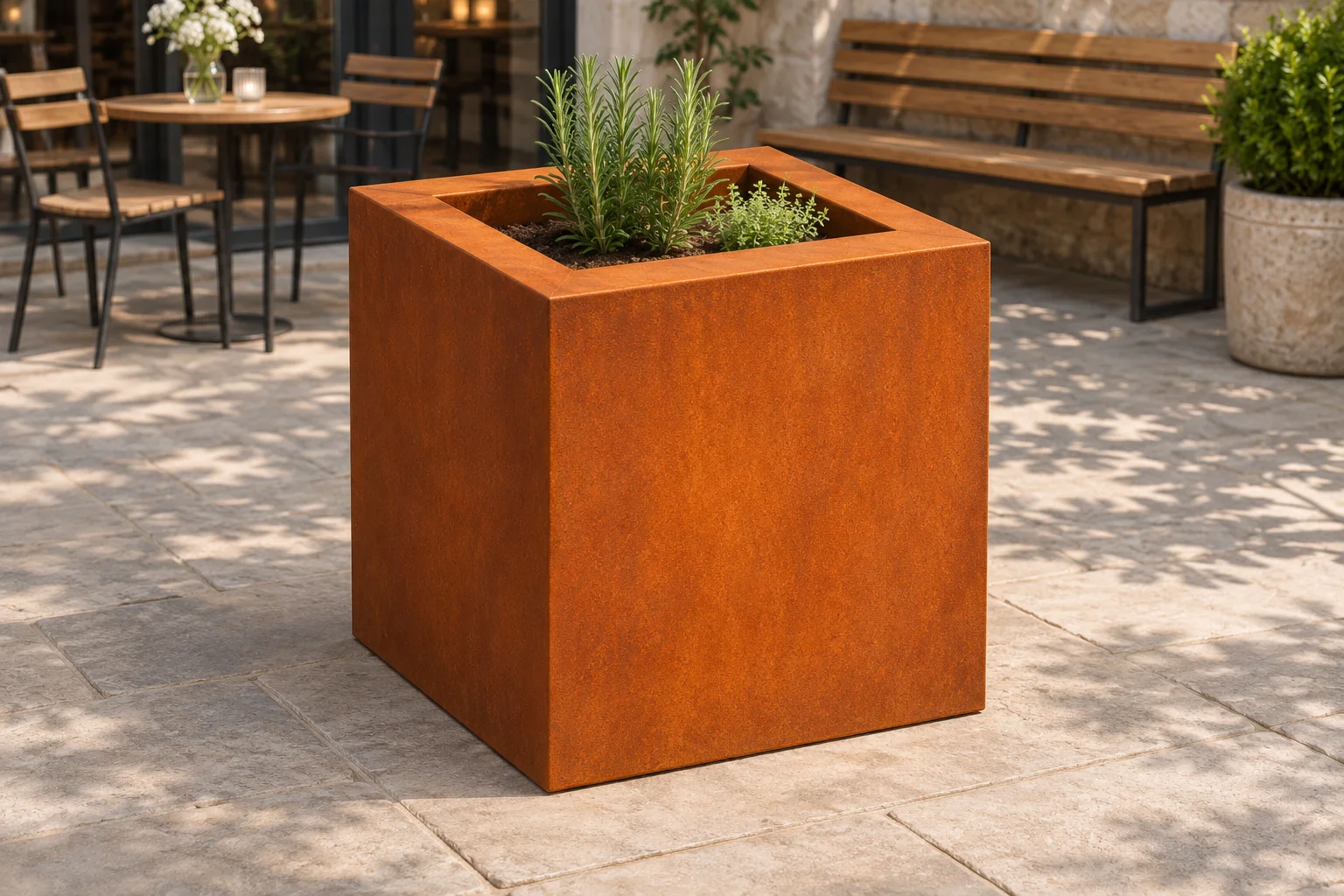
For example, the 400 × 400 × 400 mm and 400 × 400 × 700 mm models share the same external footprint but have different heights. The taller body does not have to be filled with compost all the way to its base. Agree the inner pot’s level and support as part of the design. Do not improvise a support from a material whose behaviour in damp conditions is unknown.
Plan a clear watering procedure
For a small plant, it may be convenient to remove the planting pot for watering. Afterwards, let surplus water drain and check that the pot is not returned to a concealed puddle. For a large arrangement, discuss access to collect and remove water in place. The procedure should be manageable without shifting a heavy, fully filled metal body.
Do not set one watering timetable for every plant simply from the planter’s dimensions. Frequency depends on the species, growing medium and room conditions. Advice about removing surplus water does not mean every plant should dry out to the same degree. If you use a reservoir or self-watering system, follow its instructions. Water accidentally trapped beneath a pot is not such a system.
Protect the floor from water and metal contact
Protecting against water and specifying how the body contacts the floor are separate tasks. A soft pad is not waterproofing by itself. An inner container does not guarantee freedom from leaks caused by damage or overflow. Check that supports or protective pads suit the actual parquet, stone, tile or other finish.
Before installation, check the agreed water-collection container away from both the decorative body and the finished floor. Agree the checking method with its manufacturer. After placement, carry out a controlled first watering and inspect accessible areas. Do not fill every space so that possible leak points are hidden. Decorative finishing must not remove the access required to maintain the arrangement.
Position the planter without obstructing the room
Start with the plant’s lighting requirements. An attractive empty corner may not suit the selected species. Then check the movement of doors, curtains, chairs and people, as well as cleaning access. Record dimensions together with distances to nearby objects. For a long planter, mark its entire outline on the plan, including the projecting rim.
In an office or restaurant, decide who waters the plant and who checks collected water. Assess a tall model’s stability for the actual position: shape, filling and plant work together. Do not position a composition from a photograph alone. An empty decorative body and a filled arrangement have different handling requirements; agree delivery and installation procedures in advance.
What to inspect during use
Periodically check the inner container, support, accessible joints and flooring below. Repeat after changing the plant or watering method. If water begins accumulating differently, identify the cause rather than hiding it with more filler. Damp compost and plant debris should not remain permanently against the decorative steel body.
Do not clean both the metal and floor with one unidentified product. Follow the agreed fabricator’s advice for the body and the floor manufacturer’s advice for its finish. If marks appear, photograph them and identify the moisture source. Applying lacquer or aggressive chemicals without agreement may change the product’s appearance and complicate its subsequent care.
A ready-to-use ordering checklist
Send a room photograph, floor material, desired outside dimensions in millimetres and quantity. Add the existing planting pot’s dimensions, plant name, watering method and the requirement to remove the inner container. If the plant has not been selected, do not finalise planting dimensions from the decorative body alone: agree them with your planting specialist first.
An enquiry could read: “A 400 × 400 × 700 mm planter for an office, parquet floor, plant in a separate pot; agreed corten surface condition, water collection and removal access required.” For our products, indoor construction, inner containers and floor protection are discussed separately. This specifies a maintainable arrangement rather than simply a metal silhouette of the right height.
Sources and further reading
Need a planter for your project?
Choose a model or specify your own dimensions. Include the quantity and installation location in your enquiry.
Get a quote