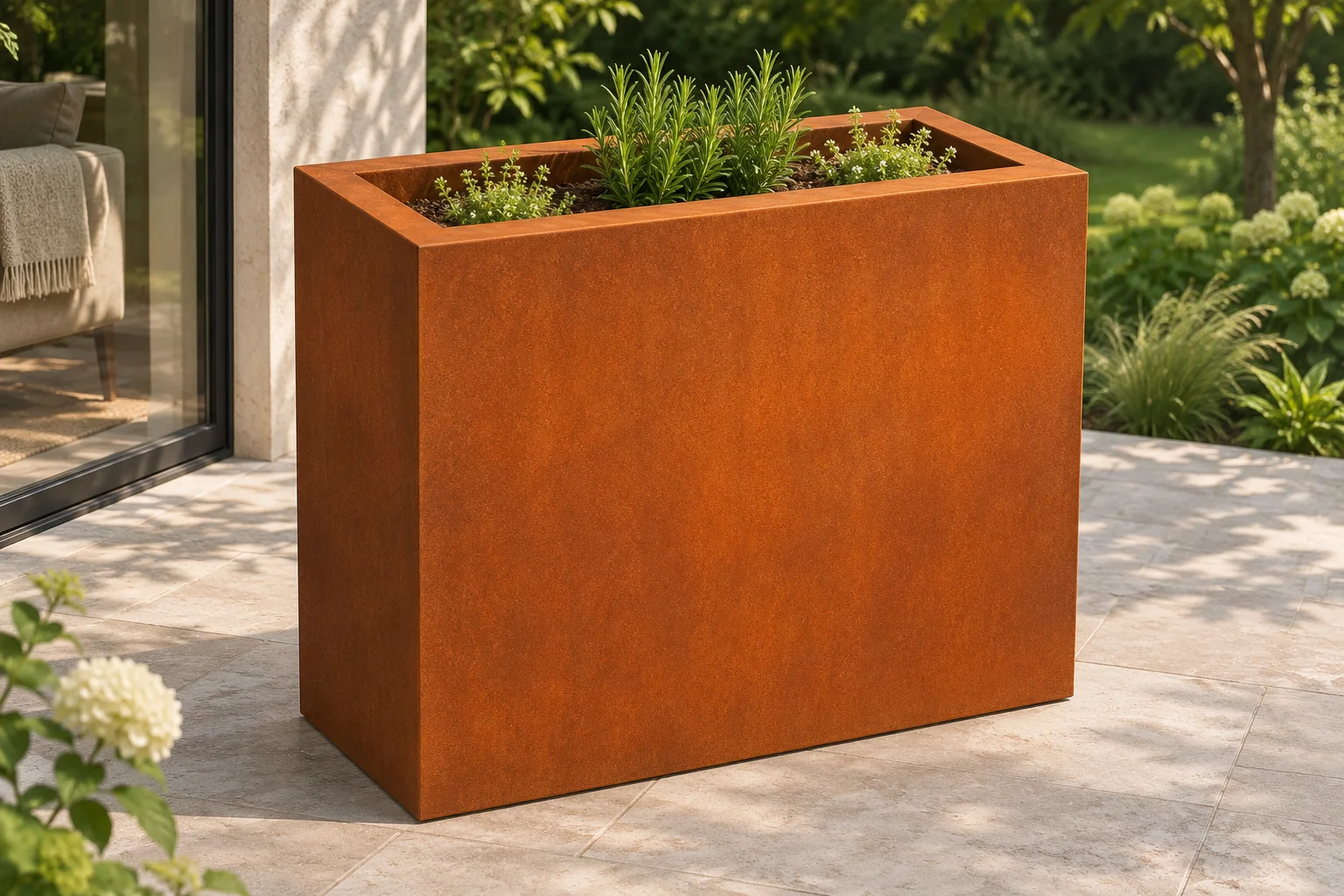
If you need an exact match to a façade or furniture colour, start by considering a specified coating system. If you want a natural brown surface that changes over time, consider corten. The final choice also depends on water, the surface below the planter and maintenance expectations. Photographs and the initial price are not enough to compare.
This guide compares an unpainted weathering-steel planter with an ordinary-steel planter finished in an agreed coating system. “Mild steel” and “powder coated” are not complete product specifications. Likewise, the word “corten” does not establish the body thickness, base design or inner planting container.
Patina and paint work differently
On corten, a protective oxide layer develops on the steel itself through alternating wet and dry periods. According to SSAB, this slows further corrosion. It is not an applied decorative colour. With a painted product, assess a separate system: the substrate, surface preparation and a coating specified for the intended exposure.
The first question for the supplier is therefore: what exactly are you buying? For corten, confirm the steel producer and product name. For a painted planter, confirm the body material, surface preparation and specific coating system. “Weather resistant” does not replace those details. Two visually identical painted models may have different specifications and care requirements.
When an exact shade matters
Corten suits a design that accepts natural changes and differences between individual pieces. Its shade depends on weathering conditions; a photograph cannot guarantee the exact colour of a finished planter. The same steel beneath a canopy and in the open can develop differently. Remember this when several planters are placed along one wall.
| Question | Unpainted corten | Coated steel |
|---|---|---|
| Appearance | Natural patina with changing shades | Agreed colour, gloss and texture |
| Surface protection | Patina under suitable conditions | A specified coating system |
| Details to request | Steel origin and surface condition | Substrate, preparation and coating name |
| Site checks | Drying and runoff route | Coating condition and runoff route |
| Price comparison | Identical construction and included components | Identical construction and included components |
If the design depends on a particular colour, agree a coated sample, gloss level and texture. A colour reference alone does not describe the entire finish. Examine the sample under the lighting at the intended location. However, do not expect a painted finish to remain completely unchanged: coating manufacturers provide separate information on weathering and maintenance.
What maintenance follows installation
One corten benefit is that the exterior paint does not need regular renewal when the material is used in appropriate conditions. This does not remove the need to inspect drainage, clear wet leaves and check places where water collects. Patina does not make a planter suitable for permanent immersion. An agreed planting arrangement matters with either option.
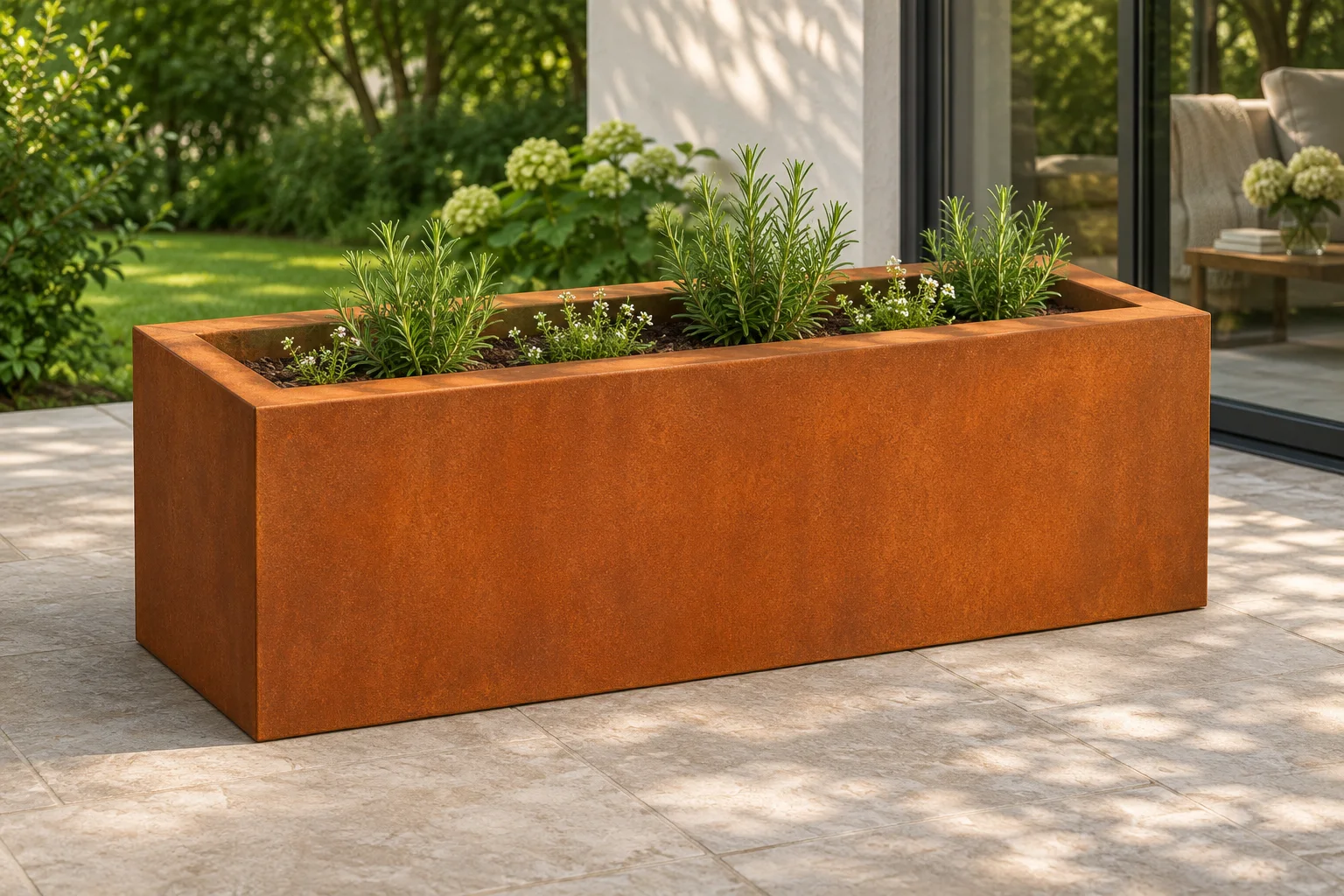
For a painted planter, request written instructions for cleaning and dealing with damage. For example, AkzoNobel describes gentle cleaning and warns against abrasive products for its Interpon D architectural powder coatings. This is an example of one manufacturer’s requirements, not a universal instruction for every paint. Follow the documentation for the actual coating used on the product.
What happens beside pale paving
During patina development, water running off corten can leave rust-coloured marks on materials below. Plan its route rather than choosing only an attractive shape. This can be decisive with porous stone or pale concrete. Drainage holes release water from the body but do not automatically protect the paving beneath it.
Do not make the opposite assumption that every painted planter is guaranteed to leave no marks. Assess the coating condition, floor contact points, irrigation and water outlets separately. Ask for the runoff route to be shown on a sketch. If even slight staining is unacceptable, that is a requirement for the whole installation, not merely for the metal’s name.
What choosing the metal does not resolve
The body material does not determine the planting depth a plant requires. Compare usable internal dimensions, not just the exterior silhouette. A 1000 × 400 × 800 mm model looks taller than a 1000 × 400 × 400 mm model, but usable volume depends on the base, rim and planting container. Do not calculate capacity by multiplying outside measurements.
Nor can stability be established from height alone. For a tall model, discuss position, filling, the plant and the possibility of accidental contact. In a public space, add cleaning and circulation requirements. These issues remain whether you choose patina or a coloured coating. Resolving them is part of specifying a planter rather than selecting a finish in isolation.
Compare two prices on the same basis
First prepare one specification: length, width and height in millimetres, quantity, base design, inner container, surface preparation and included components. Ask which work is included and which is priced separately. “A planter of the same size” tells you little if one product has a different base or a different set of components.
List location-dependent costs separately: paving protection, watering access, moving and subsequent maintenance. Do not assume invented savings over decades. Without information about the actual products and environment, nobody can honestly identify a material that is always cheaper to own. Each offer should answer the same list of requirements before you compare its final figure.
Does corten suit every environment?
No. SSAB cautions against prolonged moisture contact and salt-rich environments. A planter beside an area regularly treated with de-icing salt needs specific assessment. Hidden wet contact against a wall or persistent standing water cannot be ignored either. A naturally weathering material still places requirements on its installation location.
Indoors, do not carry the outdoor patina explanation over unchanged: a dry room does not provide the same wet and dry cycles. Agree the surface condition and separation from irrigation individually. If a supplier proposes a painted option, confirm that its coating suits your conditions as well. Naming a coating process does not establish suitability for every exposure.
What to send for a quotation
For our corten planters, send a site photograph, dimensions, quantity and a description of the surface beneath them. The material is SSAB COR-TEN®; the base, planting arrangement and indoor or outdoor construction are agreed for the order. This comparison explains alternatives; it is not an offer to paint planters or supply other steels.
A useful enquiry reads: “Two 1000 × 400 × 800 mm planters beside an entrance, natural patina, pale tiles; a base and runoff sketch is needed.” If you have another quotation, put both onto the same specification. The decision can then reflect the construction and project requirements rather than a general promise of a “better metal”.
Sources and further reading
Need a planter for your project?
Choose a model or specify your own dimensions. Include the quantity and installation location in your enquiry.
Get a quote