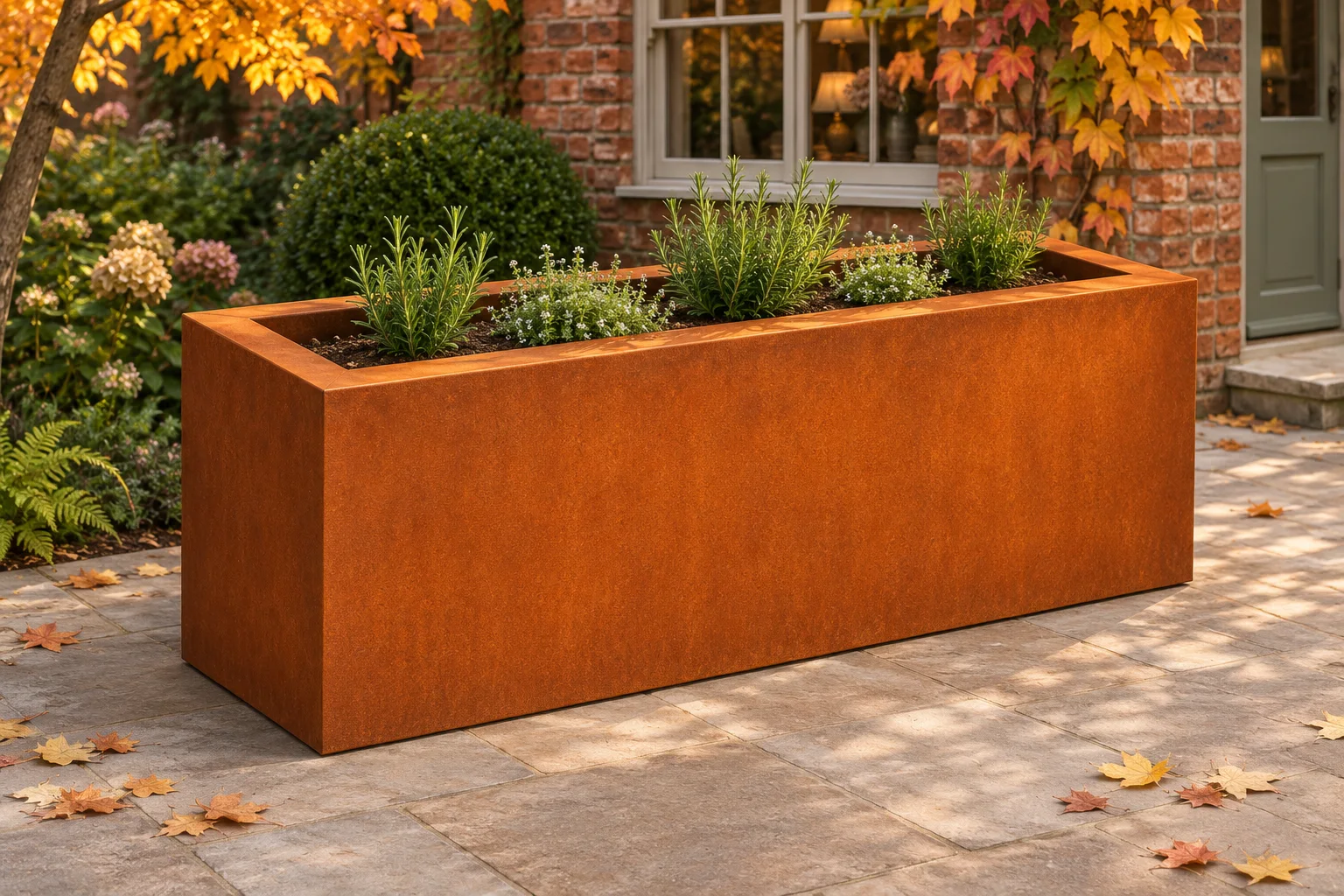
A corten planter can leave rust-coloured marks on paving. The cause is water running off the steel while its patina develops. Allow for this before installation, especially on pale stone, concrete and timber decking. Drainage holes alone do not solve the problem: they release water from the planter but do not determine where it goes next.
This guide explains how to plan runoff, what to inspect after rain and what to agree with the fabricator. It covers positioning and care, rather than a universal method for cleaning every surface. Identify the paving product, stone finish and terrace construction before ordering the planter body.
Why corten changes colour
SSAB COR-TEN® weathering steel does not retain a fixed factory colour. Its surface oxidises and, with alternating wet and dry periods, gradually develops a dense protective patina. That layer slows further corrosion. The surface may initially look lighter and more orange, becoming brown later. Exposure influences the rate and shade; the product’s age alone does not determine either.
A planter outdoors and an identical one beneath a deep canopy can weather differently. How often the steel gets wet, whether it dries after rain and whether moisture collects near its base all matter. A photograph therefore indicates the material’s character, rather than an exact future colour. For several planters in one composition, agree their surface condition at handover.
Where marks on paving come from
SSAB describes brownish runoff as a phenomenon mainly associated with early patina development. Water contacts the steel surface and carries oxidation products onto materials below. This effect decreases as the patina develops, but that is not a guarantee that staining will stop after a certain number of weeks or showers.
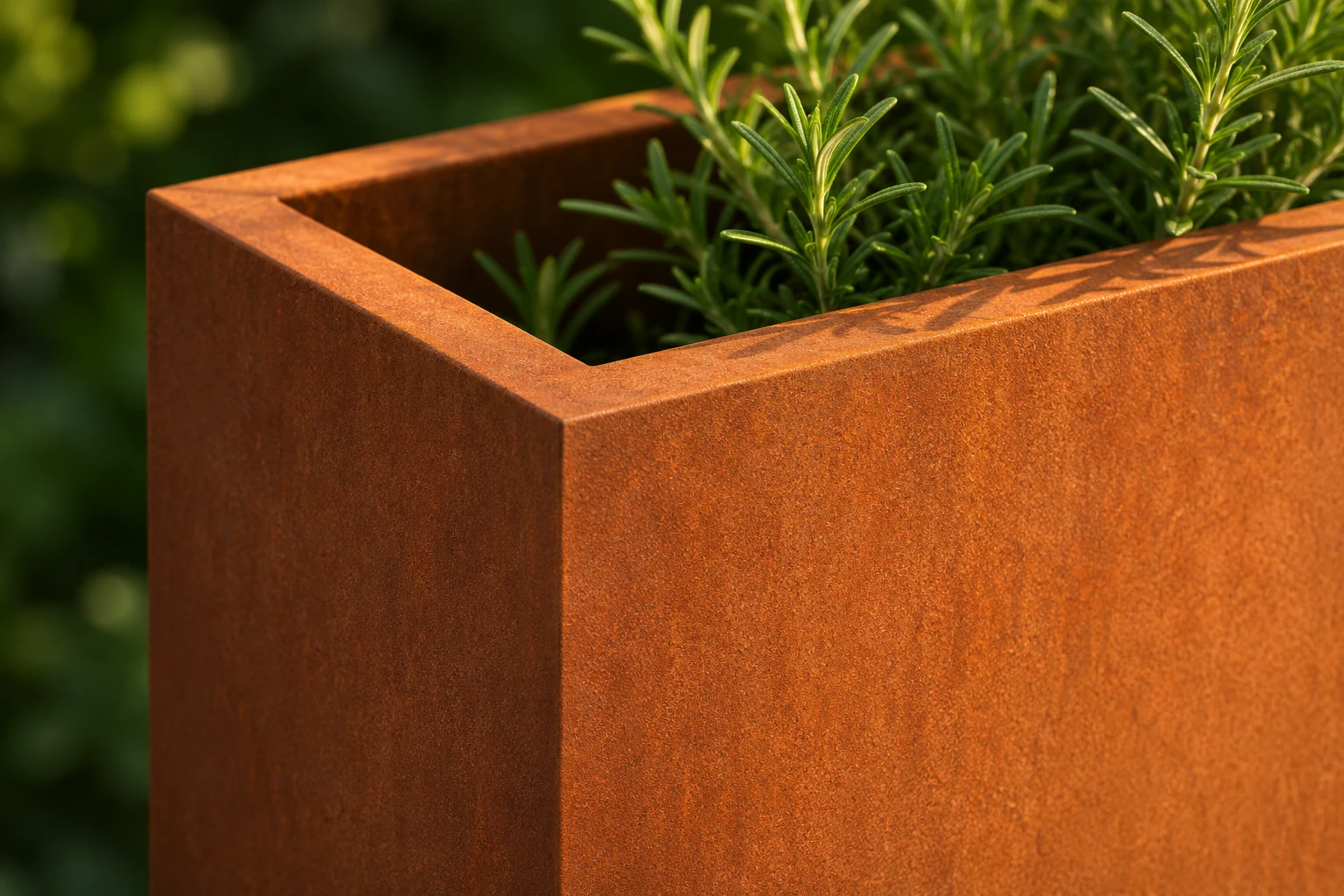
On a terrace, the repeated route of runoff matters as much as its volume: even a small flow can repeatedly reach the same spot. Check three routes separately: rain along the exterior wall, discharge from drainage holes and overflow during watering. An inner planting container does not stop rain running down the outside of the metal body.
Which surfaces need particular care
SSAB’s recommendations for architects list stone, concrete, mortar, unglazed brick and timber among materials that can stain and be difficult to clean. This calls for careful runoff design rather than automatically ruling out corten. On a sensitive surface, discuss the possibility of collecting runoff with both the terrace designer and the planter fabricator.
| Location | Main question | What to agree |
|---|---|---|
| Open terrace | Where will rainwater from the body go? | Fall, base discharge and paving protection |
| Under a canopy | Does the steel remain continuously damp? | Drying, ventilation and irrigation |
| Beside an entrance | Does water reach doors or walking routes? | Planter position and runoff direction |
| Pale stone | Are even minor marks unacceptable? | Runoff collection or another position |
The label “porcelain paving” does not by itself mean every mark will wash off easily. Check the texture and finish of the actual tile, as well as the joint material. Do not apply advice for glazed surfaces to porous natural stone. Ask the paving supplier to identify compatible cleaning products: unsuitable cleaning can create a further problem even when the original stain is small.
Plan the runoff before installation
Start with a simple plan showing the planter outline, the direction of the fall, the drainage destination and any area that must remain unmarked. Mark doors, furniture and circulation space. For a long 2000 × 500 × 500 mm model, check the whole installation line, not just one corner. A compact 800 × 300 × 400 mm planter also needs a clear water route.
Do not place a planter tightly against a surface that blocks its agreed drainage outlets. Specify supports, cleaning access and inspection space for the particular construction. There is no universal clearance for every planter. If runoff collection is proposed, it must work without continually backing water up against the steel. A solid tray permanently filled with water is not a complete solution.
What to agree in the planter design
Standard outdoor models include drainage holes. For your order, confirm outlet positions, base construction and the planting method separately. If an inner container is needed, agree whether it can be removed, how its condition will be checked and where excess water goes. Resolve these details before filling the planter with growing medium.
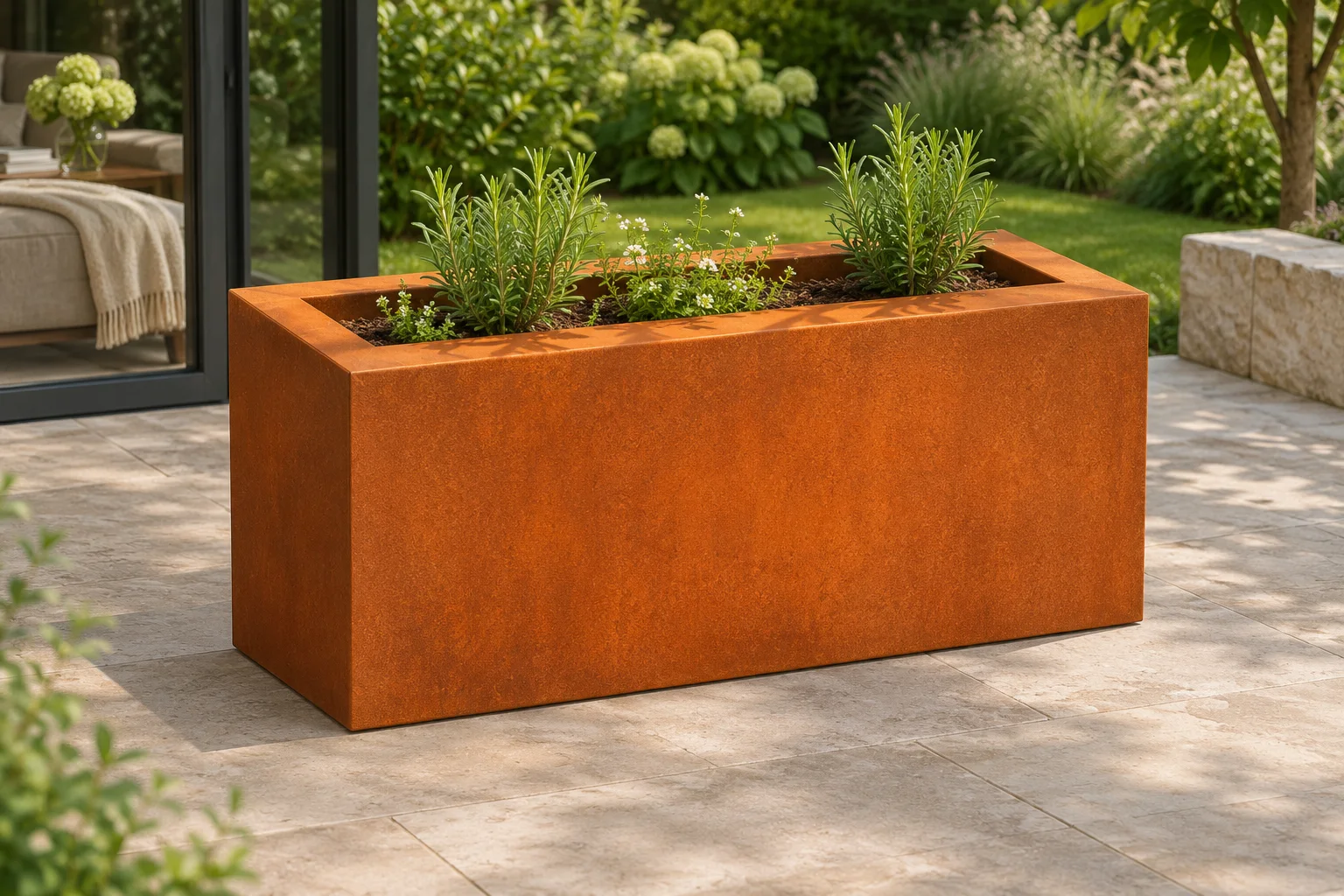
Do not calculate planting capacity from the outside dimensions: the folded rim, recessed base and inner container reduce the available space. Also distinguish water within the planting system from rain wetting the outer walls. A solution suitable for watering plants does not necessarily protect the paving from rain running down the body. Ask for both routes to be shown on a sketch, especially on a finished terrace.
Inspect after the first rain
Inspect more than the visible front face: check the back, base and paving underneath. Look for standing water, wet leaves or soil against the metal. Compare the actual runoff direction with the plan. If water reaches a door threshold or accumulates beneath the body, correct the route before persistent marks develop.
Photograph the paving and planter after installation, then again after several showers. The images help distinguish new marks from existing ones and explain the situation to the fabricator without guesswork. Inspect again after moving the planter, changing irrigation or seasonal cleaning. There is no fixed weekly timetable for every site: respond to rainfall, debris and access to the drainage outlets.
What not to do to the patina
Do not accelerate patination with de-icing salt. SSAB cautions against salt-rich environments and prolonged moisture contact, conditions that can undermine weathering steel’s performance. Do not pour unknown acidic or chlorine-containing mixtures over the body after watching a short video. A desired colour does not justify an unapproved chemical treatment of the finished product.
If stains have appeared, first identify the affected material: stone, tile or a joint. Choose cleaning according to that surface manufacturer’s instructions, including a test on a concealed area where the manufacturer permits it. We do not promise a product that safely removes rust from every paving material. Address repeated wetting at the same time: a cleaned surface will stain again if the runoff route remains unchanged.
When to change the position or construction
If a terrace has sensitive pale stone, runoff cannot be collected and even minor marks are unacceptable, say so before ordering. Discuss another planter position or a different construction. Do not buy on the assumption that the patina will quickly “set” and remove every risk without changes to the installation.
For a quote, send a site photograph, the paving material, the required dimensions in millimetres and the number of planters. Add whether there is a canopy, automatic irrigation and drainage. For example: “Two 2000 × 500 × 500 mm planters along a façade, pale stone, water directed towards a channel.” That gives us a construction to discuss, rather than just a shape in an image.
Sources and further reading
Need a planter for your project?
Choose a model or specify your own dimensions. Include the quantity and installation location in your enquiry.
Get a quote